Many organizations have brought their teams back into shared offices, but proximity alone has done little to rebuild connection. Teams adapt well when people feel safe taking interpersonal risks, a condition Harvard Business School professor Amy Edmondson calls psychological safety. However, leaders cannot require it. It tends to grow from camaraderie, which forms when people take small, real social risks together, an experience most adults rarely get.
This paper draws on research in organizational psychology and on observations from more than one hundred sessions of Inconspicuous Games, classic field games played in secret inside public landmarks. It shows how a designed constraint can change who leads and how a team works together. It closes with an honest account of what a single game can and cannot do.
Preface
It’s 5:30 p.m. on a weekday inside Grand Central Terminal. A commuter cuts across the main concourse with one eye on the departures board, running for their train. A bride holds still on the marble staircase while the photographer captures her look. Someone rolls their suitcase in from a platform, arriving in New York for the first time and trying hard not to look like a newcomer. Beside the legendary information booth, two friends spot each other across the crowd and wave.
This is one of the busiest rooms in New York and one of the easiest places in the city to go unnoticed.
What almost none of them would guess is that thirty people in this room are playing Capture the Flag.
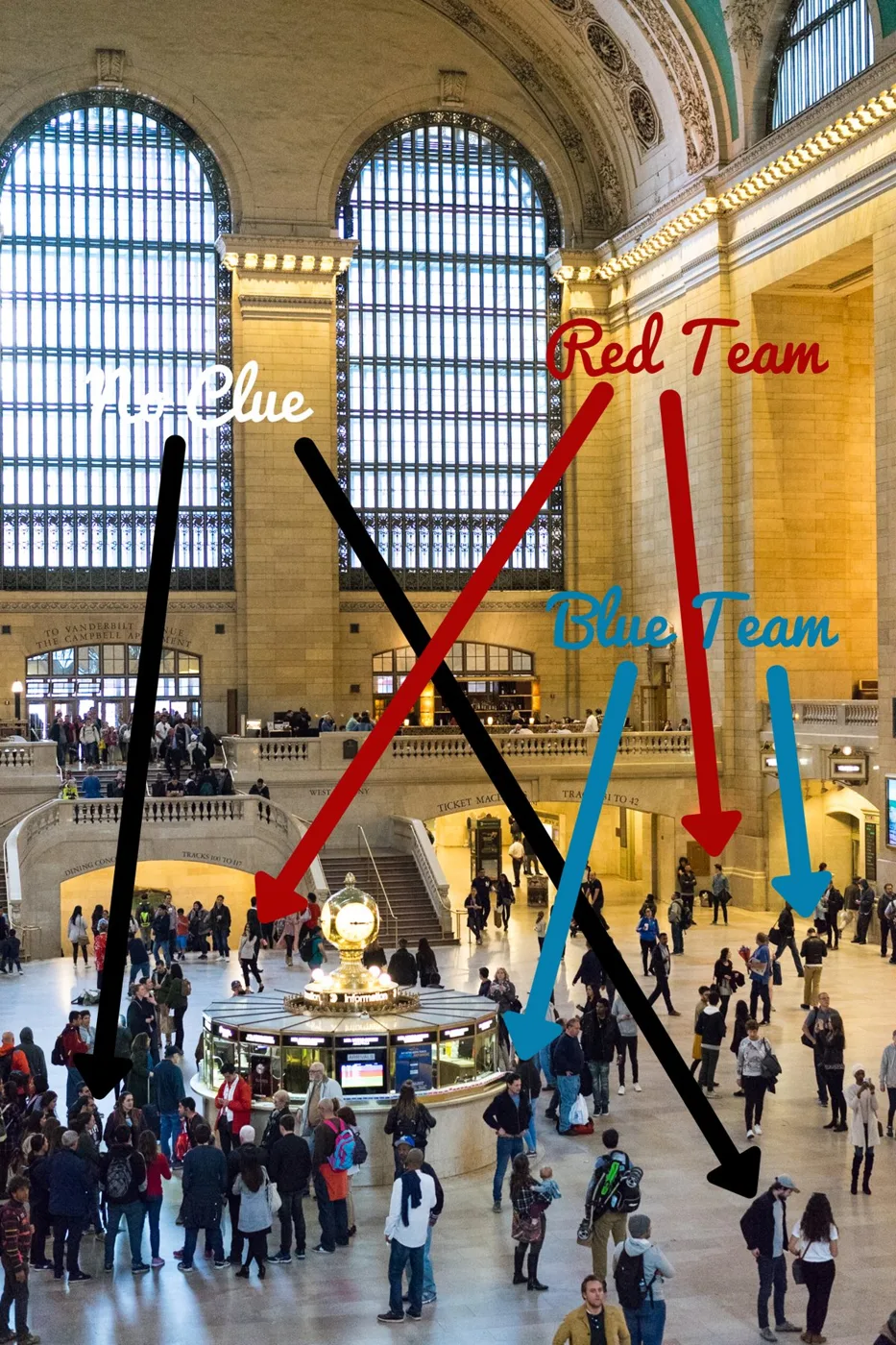
The players are walking, speaking in low voices (if they’re even speaking at all). They look like everyone else, apart from a small red or blue pin worn on a lapel or a bag strap. Think spies, not soldiers. Somewhere on the far side of the concourse, a flag is hidden in plain sight, and a team of colleagues is working out how to bring it across the center line without getting caught by the other team. The hundreds of strangers around them must never notice either. That’s the rule that makes this game what it is.
A game runs about ninety minutes. Teams play in short rounds, and between each one they huddle for two minutes to compare what they saw and change the plan. Two game runners keep time and keep the play safe for everyone in the space.
The game is called Inconspicuous Games. Its founders, Molly Sonsteng and Sam Utne, have run it more than a hundred times in museums and landmarks across New York City and Minneapolis since 2016. This paper looks at what happens to a team during a game like this and why it matters to organizations trying to help people work well together. It draws on research in organizational psychology as well as what the founders and their clients have observed along the way.
01The proximity problem
Return-to-office mandates have spread over the past year. In a 2025 CBRE survey of 184 U.S. companies, 37% said they were enforcing their attendance policies, up from 17% the year before. Behind many of these policies sits a simple hope. People who share a building will trade ideas more freely and better work will follow.
So far, the evidence suggests proximity alone, however, does less than hoped. In 2026, Kahoot!, a company that sells workplace engagement tools, surveyed 2,000 office workers. Of those workers, 40% said they had felt lonely at work while surrounded by colleagues, and 37% said they had no close friends at work. Sharing a room is different from sharing an experience.
Research on hybrid work points toward why. Urrila and colleagues (2025) interviewed expert employees at two points between 2020 and 2022. They found that onsite days built a sense of belonging when they offered genuine human connection and when being there felt relevant. Presence gives people the chance to connect. Something still has to happen once they arrive, though.
Most teams already know each other’s names and job titles. What they rarely share is the experience of figuring something out together with their usual roles set aside.
That leaves People and L&D leaders with a practical question. If the room is insufficient on its own, what actually builds the kind of connection that changes how a team works together? The answer starts with what teams need to be able to do.
02The capability teams need
Ask leaders what they want most from their teams and the answers tend to land on some version of adaptability. Plans change and reorganizations arrive. The teams that cope well are the ones that can change how they work together when the usual script stops working.
Researchers call this team flexibility. In a study of 602 employees across 108 teams and 43 organizations, Ling and colleagues (2021) found that employees on more flexible teams behaved more adaptively and proactively during organizational change.
A team’s flexibility depends on who gets heard. When Woolley and colleagues (2010) tested groups on a wide range of tasks, the strongest groups were the ones where people spoke in roughly equal turns. Having one very smart member mattered far less.
Researchers who study group dynamics have been naming these patterns for decades. In one of the earliest accounts, Benne and Sheats (1948) described the roles people take on in groups, from the initiator who proposes ideas to the harmonizer who smooths conflict. Most teams fall into versions of these roles without anyone choosing them. One person always speaks first. Another waits, then sends a thoughtful message after the meeting ends. Someone keeps the peace, and someone else cracks the joke that breaks it. These defaults help a team move quickly. They also narrow whose ideas reach the decision. In an ordinary meeting, where everyone already knows their part, they’re hard to change.
Trying on a new role takes nerve. It means doing something unfamiliar in front of colleagues who already think they know what to expect. That is a social risk and it’s something adults rarely get to experiment with. A team can only be as flexible as its people are willing to try something new.
03Social risk
Harvard Business School professor Amy Edmondson gave this idea its best-known name. In a 1999 study of 51 work teams, she defined team psychological safety as “a shared belief held by members of a team that the team is safe for interpersonal risk taking.” Teams with more of it were more likely to talk openly about mistakes and try new approaches. Those learning behaviors, in turn, predicted better performance.
The phrase has since become familiar in most HR departments and it’s often mistaken for comfort. Edmondson drew that line herself. A close, agreeable group can grow less willing to disagree which is the opposite of what she was describing. Psychological safety is the confidence that a person can take a risk in front of the group without being embarrassed or shut down for it.
Underneath the definition, the active ingredient is risk. Safety is a belief and beliefs come from experience. A team learns that it can take interpersonal risks by taking some and seeing what happens. This paper calls those moments social risks: speaking first in a room full of senior people or admitting out loud that a plan was wrong.
Childhood is full of small social risks. Picking teams at recess, raising a hand with a half-formed answer, showing up on the first day at a new school, daring a friend to do something slightly ridiculous. Adult life removes most of them. Work in particular raises the cost of looking foolish, because reputations and performance reviews ride on it. Many adults can go years without a low-stakes chance to try something in front of others and get it wrong.
This is where play earns its place in a serious conversation. Psychologist Barbara Fredrickson’s broaden-and-build theory proposes that positive emotions widen the range of thoughts and actions people consider in the moment. Over time, those moments help build lasting resources, including social ones. Play researcher Stuart Brown makes a related case in his book Play (2009), arguing that play gives people a place to rehearse and experiment at lower stakes.
Taken together, the research points to a practical conclusion. Teams need chances to take social risks that are real enough to feel and small enough to enjoy. Those risks have the most positive impact when a group takes them together.
04Camaraderie as the bridge
Psychological safety resists policy. A handbook can tell people to speak up but it still falls to the people in the room to make speaking up feel safe.
Fresia Jackson, Director of People Science Research at Culture Amp, describes camaraderie as the mediator between bringing people back together and the creativity organizations hope will follow. Many organizations are bringing employees back hoping for exactly those outcomes, she says, but “simple proximity does not automatically make someone feel able to take part in the behaviors that lead to innovation.” Speaking up and building on each other’s ideas take confidence, and camaraderie helps build it.
Research on camaraderie itself is still thin, but the closest studies follow the same path. In a 2023 study of 428 white-collar employees, workplace friendship predicted creativity, partly because friendship helped people feel psychologically safe. The study traces the same chain Jackson describes.
Shared ordinary activity seems to matter as well. Studying a large U.S. city fire department, Kniffin and colleagues (2015) found that crews who cooked and ate together more often were rated as higher performing by their officers. The firefighters described their crews as family.
Even mild shared discomfort can bring people together. In experiments by Bastian, Jetten and Ferris (2014), small groups were randomly assigned to a mildly painful task, like fishing metal balls out of a bucket of ice water. Compared with groups given an easier version, the groups who suffered together reported stronger bonds and cooperated more in a game afterward. The groups had been put together at random and shared nothing beyond the task itself.
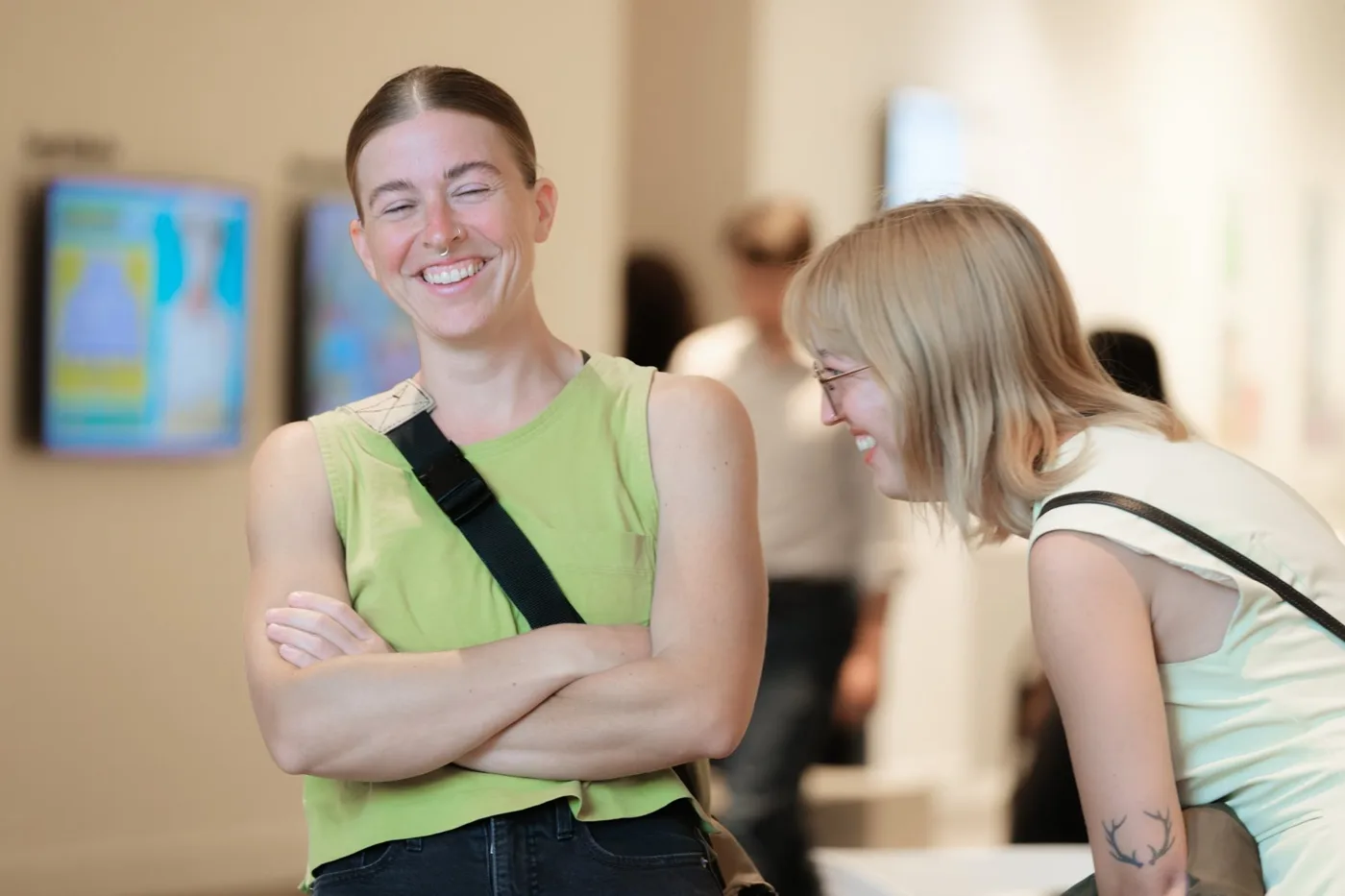
A team that’s taken a risk together and come out laughing has firsthand evidence that its members can rely on one another. Organizations can’t mandate that evidence, but they can offer the occasions where it gets made.
05Secrecy as the mechanism
Inconspicuous Games started as a joke. In 2016, Sonsteng and Utne were standing in the Temple of Dendur at the Metropolitan Museum of Art when they noticed the room had perfect natural boundaries for Capture the Flag. A few weeks later they tested it with twenty friends. To make it work in a museum, they changed the rules: players had to move at a walking pace and avoid being noticed, by the other team or by anyone else in the building.
What surprised the founders was who thrived. The quietest people in the group shined and the loudest ones took a back seat. As it turns out, the rules they modified were the design. Each one strips away an advantage that usually decides who leads.
A walking pace takes speed and strength out of the equation. Secrecy takes volume out as well. A plan shouted across a concourse gives the game away so teams coordinate through glances and positioning. The people who notice small details become the most useful players on the field. The person who usually talks first has to find another way to lead. In effect, the rules push a team toward the more even turn-taking that Woolley’s research linked to stronger group performance.
The game also treats blending in as a skill and it features that skill on purpose. Players who are good at going unnoticed (often the same people who hold back in meetings) can cut straight through a crowd without being detected. A Rockets of Awesome employee described what that looked like on their team: “quiet folks turned out to be master strategists and more extroverted teammates blended into the woodwork and got sneaky.”
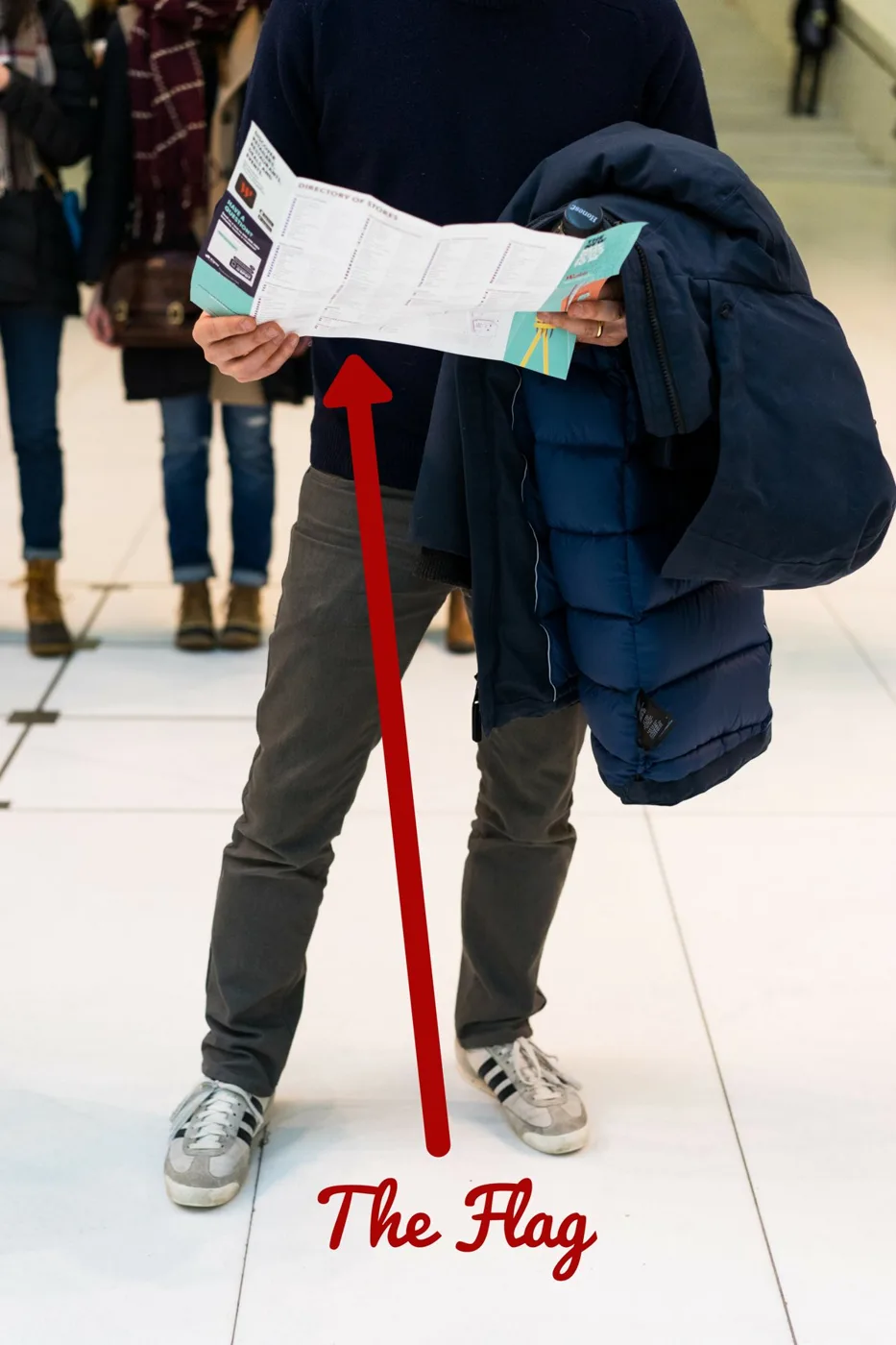
Secrecy shapes the team as much as the strategy. Every player is managing the same small risk at the same moment, the risk of being seen, and only their own team knows what they’re doing. The lapel pin makes that in-group literal.
Office hierarchy has little to hold onto in this setting. A CredSimple player said the team got to “organize and strategize in a way that was completely separate from any individual’s role in the office.” At bullfrog+baum, a player noticed that the team “listened to each other’s ideas, which was nice for some of our junior staff who don’t speak up very often.”
The game also builds in real-time reflection. Teams play a round, huddle, tweak their strategy, and play again. This is the same cycle of experience and reflection that David Kolb described in Experiential Learning (1984). Between rounds, the game runners can change the rules, like letting the flag move or adding conference calls, so a plan that worked the previous round suddenly needs rethinking.
By the end of a game, a team has watched its usual order rearrange itself and has practiced working well without it. That is exactly the kind of occasion an organization can create.
06Beyond the org chart
The first Inconspicuous Games players were twenty friends and the game has since been played by groups with very different relationships. Corporate teams make up most of its players. It’s also led games for program cohorts like founders in a Techstars accelerator program, and for groups of interns at charity: water’s summer class. Through Airbnb Experiences, it brought together people who met for the first time that day.
The effect looks similar across all of them. A player from bullfrog+baum who had played both with friends and with coworkers enjoyed both, and found the office version especially rewarding: “We really got to work together in a different way than in an office environment.”
That range matches the research. In the ice-water experiments described in section 4, the groups were assigned at random and still bonded. For People leaders, this matters more than it might seem. New hires and newly merged teams often start out closer to strangers than to friends and they’re the groups that most need a shortcut to trust.
07Questions People leaders ask
How is this different from an escape room or a scavenger hunt?
Escape rooms and scavenger hunts are good at getting a team to solve a puzzle together. The challenge in Inconspicuous Games is coordination under social risk. Players work with imperfect information about where the other team is and every move happens in public where the goal is to go unnoticed. The difference that matters for a team is the constraint. When speed and volume stop working, the game changes who leads.
Is it risky to play in a public space?
The game is built to be low impact. Players walk and keep their voices down. The central rule is that bystanders should never notice a game is happening. Two trained game runners lead every game from start to finish. Most of the venues where games are played have given their permission and every game is designed around the code of conduct of the space it’s in. A player who follows the rules of the game is, by design, following the rules of the venue.
Does it work for everyone on a team?
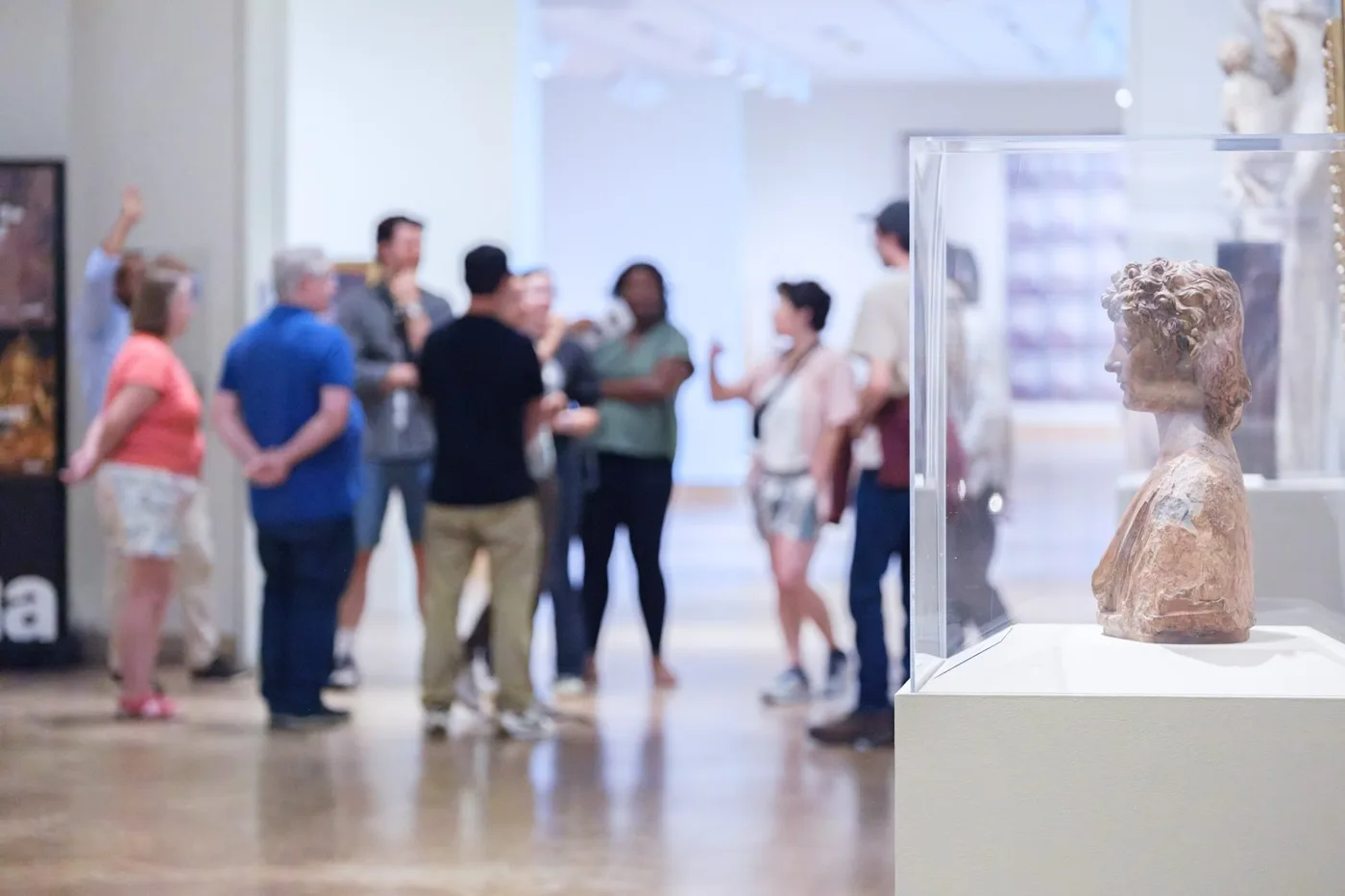
Inconspicuous Games is played at a walking pace, and routes can include elevators and ramps, so players using wheelchairs and other mobility aids have taken part alongside their teams. The game rewards observation and discretion over speed or volume, which tends to level the field between outgoing and quieter team members.
How do we measure the impact?
The honest answer is that the effect has been observed rather than measured. Across more than a hundred games, Inconspicuous Games has gathered feedback from the groups it hosts, and in post-game surveys every respondent has rated it a 4 or 5 out of 5. Those responses were self-selected and came mostly from the people who organized each game, so they speak to the experience more than to its lasting effect.
For organizers who want to see whether something shifted, a few signals are worth watching in the weeks after a game:
- Who speaks first in meetings and whether that changes
- Whether people from different teams seek each other out
- Whether the game turns into shared shorthand
- Whether quieter team members are brought into decisions more often
08What one game can and cannot do
A ninety-minute game is an occasion for camaraderie. One game will not fix a culture or move a revenue number. Teams with deeper problems will still need deeper work.
The experience also suits some people better than others. One player who dislikes competitive games said they would have preferred something more collaborative.
The evidence has limits too. Most of the research cited here is correlational, and the observations about the game come from its founders and from feedback that players chose to give.
What a game can do is add one vivid, shared experience to a team’s history. Psychological safety builds from experiences like that, accumulated over time, and it lasts longest when organizations keep creating them. Camaraderie grows in moments. Organizations can make more of them.
More about Inconspicuous Games at inconspicuousgames.com.
Photographs: Anna Sapra (Grand Central and the Oculus) and Peter Aehl (Minneapolis Institute of Art).
References
- Bastian, B., Jetten, J., & Ferris, L. J. (2014). Pain as social glue: Shared pain increases cooperation. Psychological Science. doi.org/10.1177/0956797614545886
- Benne, K. D., & Sheats, P. (1948). Functional roles of group members. Journal of Social Issues, 4(2), 41–49.
- Brown, S., with Vaughan, C. (2009). Play: How it shapes the brain, opens the imagination, and invigorates the soul. Avery.
- CBRE. (2025, August 11). Employees and employers closer to being on the same page about in-office work [Press release]. cbre.com
- Edmondson, A. (1999). Psychological safety and learning behavior in work teams. Administrative Science Quarterly, 44(2), 350–383.
- Fredrickson, B. L. (2001). The role of positive emotions in positive psychology: The broaden-and-build theory of positive emotions. American Psychologist, 56(3), 218–226. doi.org/10.1037/0003-066X.56.3.218
- Furney, W. (2026, July 6). Return to the office “has not rebuilt workplace connections.” HRreview, reporting a Kahoot! survey of 2,000 office workers. hrreview.co.uk
- Geylan, A. (2023). The mediating role of psychological safety in the impact of workplace friendship on creativity. Asya Studies, 7(25), 217–232. doi.org/10.31455/asya.1348986
- Jackson, F. (2026). Personal communication with the authors, November 2026.
- Kniffin, K. M., Wansink, B., Devine, C. M., & Sobal, J. (2015). Eating together at the firehouse: How workplace commensality relates to the performance of firefighters. Human Performance, 28(4), 281–306. doi.org/10.1080/08959285.2015.1021049
- Kolb, D. A. (1984). Experiential learning: Experience as the source of learning and development. Prentice-Hall.
- Ling, B., Liu, Z., Chen, D., & Sun, L. (2021). Team flexibility in organizational change context: Antecedents and consequences. Psychology Research and Behavior Management, 14, 1805–1821. doi.org/10.2147/PRBM.S332222
- Urrila, L., Siiriäinen, A., Mäkelä, L., & Kangas, H. (2025). Sense of belonging in hybrid work settings. Journal of Vocational Behavior, 157, 104096. doi.org/10.1016/j.jvb.2025.104096
- Woolley, A. W., Chabris, C. F., Pentland, A., Hashmi, N., & Malone, T. W. (2010). Evidence for a collective intelligence factor in the performance of human groups. Science, 330(6004), 686–688.